Best & Most Beautiful
ISLANDS IN THE GULF OF THAILAND

Best & Most Beautiful
ISLANDS IN THE ANDAMAN

Thai Elephant
THE SYMBOL OF THAILAND


Best kid’s amusement park in Bangkok.
Bangkok
Best of Bangkok Sightseeing Tours
Grand Palace & Temple of the Emerald Buddha or Wat Phra Kaeo
|
|
This is the most famous place that is a must for all tourists. It is a large compound located near Sanam Luang in the very heart of Bangkok. The Grand Palace and the Temple of the Emerald Buddha were built after King Rama I ascended the throne as the founder of the Chakri Dynasty on 6 April 1782 and have undergone several repairs and renovations. The Grand Palace consists of several buildings with different styles of architecture. Wat Phra Kaeo is renowned as the most beautiful and important Buddhist temple in Thailand. It houses Phra Kaeo Morakot (the Emerald Buddha), the most highly revered Buddha image carved from a single block of fine jade. |
|
|
Scattered in the temple grounds are numerous interesting sculptures of artistic value, including the fanciful animals in mythology, the fierce-looking giants standing guard at the gates, the six pairs of Cambodian-style bronze lions and the stone figures from China. On the inside walls of the temple's compound, there are extensive mural paintings depicting scenes from the famous epic "Ramayana". It is the longest wall painting in the world as well as one of the Unseen Bangkoks. A distinctive characteristic of this temple is that there are no monks living in it like other temples. |
||


Chakri Maha Prasat, Grand Palace
 |
Chakri Maha Prasat, Grand PalaceAmong the four groups of palaces, the Chakri Maha Prasat is the largest and most famous. Erected by King Rama V in 1882 as his own residence, the 3-storey building is a mixture of Thai and Western architecture. The top part is pure Thai with tapering spires and tiered sloping roofs, and the lower parts, designed by a British architect, are in the Imperial Victorian style. Boromphiman Hall This French-inspired structure was | |
|
built by King Rama V for Crown Prince Vajiravudh as his residence. It is now used to accommodate visiting foreign heads of state. |
||
|
Proper Dress in the Grand Palace for Visitors Visitors are requested to be dressed properly and appropriately upon entering the ground of the Grand Palace. Thus the following dress code (applicable to both ladies and gentlemen) will be strictly enforced:
|
||

King Rama II Memorial Park
I had thought that the strong sunshine in the afternoon of the summer might diminish the pleasure of my trip to Samut Songkhram, a small province only 63 kilometres to the southwest of Bangkok, but the leisurely lifestyle of the local people and the sight of lush orchards here and there in the province made me forget the crowded city of Bangkok and feel refreshed so much.
Not having many popular tourist attractions, Samut Songkhram may not be appealing to many tourists, but my trip proved that there are still a lot of things and places to explore in this province. The press tour of the province that I joined started at 1 p.m. As we approached the province. I saw many orchards along the way after passing a stretch of salt farms on both sides of the highway.
Our guide, a local teacher in the province, told us that Samut Songkhram, though small, is abundant in fruits, vegetables and aquatic lives for the province is situated near the mouth of the Mae Klong, a major river of the Central Plains. People there lead a simple life. There is thus no need for them to be in a big hurry when doing anything.
Soon we reached our first destination Wat Phet Samut Worawihan regarded as the most important temple of the province. Enshrined here is the Buddha statue of Luang Pho Ban Laem which is highly venerated among the locals. Inside the temple there is also a museum of Buddha statues and images and some relics of the old days. It is a Thai practice that when visiting a place, the visitors always take an opportunity to pay homage to a Buddha statue in the region in order to ask for the Buddha's blessing and protection for their travel. So the temple served as a suitable first stop of our tour.
For me the highlight of this trip is King Rama II Memorial Park. This small province was the hometown of King Rama II (1809-1824). The King was posthumously honoured by UNESCO in 1968 as one of the Great Personalities of the world who had brilliant attainments in his lifetime as a great poet, warrior, artist, ruler and sculptor. As a tribute to the king, a memorial park was built in Amphawa county on the Mae Klong in 1979.
A group of five magnificent Thai-style wooden houses in a park were in my sight, arousing my curiosity to see what was inside. I learned from the guide that the trees and plants in the park had much more meaning than just decorations to the place. They are those mentioned in several works of Thai literature while many have medicinal properties, too. Four traditional Thai houses serve as a museum where a beautifully carved and painted bed once used by the king and many artistic objects reflecting the lifestyle of Thai people in the old days are on show while the other house is just for recreational activities of children.
The park is located next to the Mae Klong River. We had a chance to gain the impressive view of the river. Sometimes I feel that the difference between a river and the sea is that people have a closer relationship with the river which is like a common thread that ties them together and gives life to everywhere it runs through, closer than the sea which is just their mere acquaintance. The guide told us that on the other side of the river is located Wat Phummarin Kudi Thong with historical significance related to the Queen of King Rama I. A millionaire who was the father of Khun Nak, the future queen, once went to ask the abbot of Bangli Temple also located next to the river, to foretell the future of Khun Nak.
The guide told us that on the other side of the river is located Wat Phummarin Kudi Thong with historical significance related to the Queen of King Rama I. A millionaire who was the father of Khun Nak, the future queen, once went to ask the abbot of Bangli Temple also located next to the river, to foretell the future of Khun Nak.
As the abbot predicted that Khun Nak would become a queen, the millionaire was very glad to hear that and promised that if the prediction came true, he would build a gold house (Kudi Thong in Thai) in the temple compound.
The accuracy of the abbot's prediction was finally proved and the millionaire intended to fulfill his promise. But it was impossible to erect a building of gold, so instead, he built one from golden teakwood (or maisak thong), in which the word thong signifying gold appears in the name.
As time passed, the land of Bangli Temple was severely eroded by the river water, and the bank collapsed. Kudi Thong was thus dismantled and moved to the compound of the nearby Wat Phummarin. The temple is now called Wat Phummarin Kudi Thong. It is a pity that we had no time to visit the temple as we heard that it had a museum exhibiting ancient Buddha statues and some properties of King Rama I and his queen when they were ordinary people.
To my surprise, besides several places related to Buddhism, Samut Songkhram boasts the oldest and the most magnificent church of Thailand. Mae Phra Bangkoet Church was built in the Gothic style in 1890. There are 14 pieces of stained-glass imported from Italy decorating the windows around the church with attractive pictures depicting important scenes of Jesus Christ's life. It was amazing to find that they were all still in a good condition despite never undergoing any repair.


The program including 4 temples and 1 palace: Wat Arun (The Temple of Dawn), Wat Benchamabopith (The Marble Temple), Wat Trimitr (The Golden Buddha), Wat Pho (The Temple of Reclining Buddha), The Grand Palace & The Temple of the Emerald Buddha (Wat Pra Kaew).
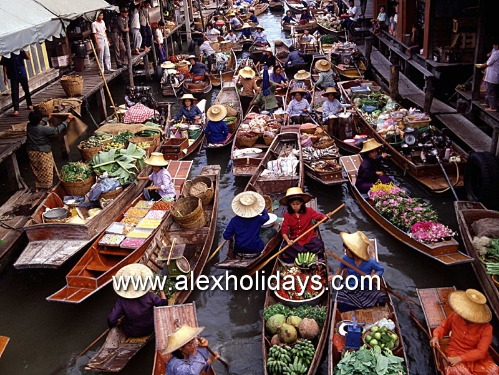
This authentic floating market is one of the most photographed places. It is located in Ratchaburi, about 100 km from Bangkok. Take a long-tail boat to the Floating Market where you will see the lifestyle of Thai people along the canal. Many vendors floating in their small rowing boats selling local food.
 Alex Holiday is a Bangkok-based travel agent, operating tour services and providing hotel reservations all over Thailand. We specialize in cultural, trekking, adventure and golf tours as well as other tailor-made tour packages. We can organize all kinds of travel for you. More details...
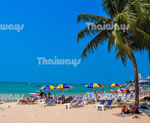
Pattaya Beach is divided into the north, central and south zones. The beach offers excellent facilities for watersports enthusiasts of all kinds.

Patong is the most famous beach in Phuket. With its wide variety of activities and nightlife, it is an ideal place to relax, party and play.

This 7-km beach is the longest and the most popular beach on the east coast of Ko Samui. It has clean white sand and clear blue water.

A popular beach destination about 3-hour drive from Bangkok. Its long sandy beach with a relaxed atmosphere is great for family holiday.