Best & Most Beautiful
ISLANDS IN THE GULF OF THAILAND

Best & Most Beautiful
ISLANDS IN THE ANDAMAN

Thai Elephant
THE SYMBOL OF THAILAND


Best kid’s amusement park in Bangkok.
Custom
•Thailand is a Buddhist country where Buddha images are held sacred. Sacrilegious acts are punishable by imprisonment even if committed by foreign visitors.
•Thai people hold their King and Queen and the Royal Family in great reverence, and so won't tolerate foreigners showing disrespect to them.
•Generally Thai women are conservative. So don't touch them without their consent.
•Dress properly when entering a Buddhist temple. Miniskirts and shorts are not allowed. Take your shoes off before going inside the hall of worship. Ladies must not on any account touch a Buddhist monk, give things direct to him or receive things direct from him.
•Intimacies between man and woman should not be shown in public. Sunbathing in the nude is prohibited.
•Call Thais their first names; use the title "Khun" for adults.
•Normally, Thai people address others by their first names and with the title 'khun'. So don't be surprised if you are addressed as 'Khun Mary' or 'Khun John' instead of by your surname.
•Traditionally, Thais greet each other with a wai (by pressing the palms together at the chest). If someone wais you, you should wai back (exceptwai-ed by a child).
•Thai people smile to express gladness and happiness, to thank for small services, to return the wai of children and inferior persons, and even to excuse small inconveniences.
•Don't touch a person's head, nor ruffle his hair. The head is the noblest part of the body. A sincere apology should be offered immediately if you touch someone's head unintentionally.
•Avoid placing your feet on the table while sitting. Never use your foot to point things out or to touch any part of the body of anyone, which is considered rude.
•Entering a Thai house, you're expected to remove your shoes.
Visa
The following information about Thailand's visa information is obtained from the Office of the Immigration Bureau, Ministry of Foreign Affairs.
Tourist Visa Exemption
The Thai government allows nationals from 41 countries and 1 special administrative region to stay in Thailand for tourism purpose for up to 30 days without an entry visa.
List of 41 countries are as follows:Australia, Austria, Belgium, Brazil, Bahrain, Brunei Darussalam,Canada, Denmark, Finland, France, Germany, Greece, Hong Kong, Iceland, Indonesia, Ireland, Israel, Italy, Japan,Korea, Kuwait, Luxembourg, Malaysia, Monaco, Netherlands,New Zealand, Norway, Oman, Peru, Philippines, Portugal, Qatar,Singapore, Spain, South Africa, Sweden, Switzerland, Turkey, United Arab Emirates, United Kingdom, USA, Vietnam.
Temporary Tourist Visa : Visa on Arrival
Passport holders from 21 countries may apply for visas at the immigration checkpoints for the purpose of tourism for the period of not exceeding 15 days.
Documents required: Valid passport, visa application form completely filled in, confirmed air ticket paid in full, one recent photograph (4x6 cm), and application fee of 1,000 baht.
Validity of stay: 15 days
The visa is granted by Immigration officers at 24 designated international checkpoints located in Thailand's international airports -- Bangkok, Phuket, Chiang Mai, Hatyai, and at other points of entry into the country.
List of 21 countries are as follows:
Bhutan, China, Cyprus, Czech, Estonia, Hungary, India, Kazakhstan, Latvia, Liechtenstein, Lithuania, Maldives, Mauritius, Poland, Russian Federation, Saudi Arabia, Slovakia, Slovenia, Taiwan, Ukraine
Transit Visa
Documents required:
1. Passport or travel document with validity not less than 6 months
2. Visa application form completely filled out
3. One recent photograph (4x6 cm)
4. Confirmed air ticket paid in full
5. Evidence of adequate finance (20,000 Baht per person and 40,000 Baht per family)
6. Visa of a third country in a passport or travel document
Visa fee : 800 baht per entry
(The fee may be changed without prior notice.)
Validity of stay: 30 days
Tourist Visa
Documents required:
1. Passport or travel document with validity not less than 6 months
2. Visa application form completely filled out
3. One recent photograph (4x6 cm)
4. Confirmed air ticket paid in full
5. Evidence of adequate finance
(10,000 Baht per person and 20,000 Baht per family)
Visa fee: 1,000 baht per entry
(The fee may be changed without prior notice.)
Validity of stay: 30 days or 60 days for nationals of countries on Thailand's
Tourist Visa Exemption List
Extension of Stay
Those who wish to stay longer or may wish to change their status of visa must file an application form at the Office of Immigration Bureau located on Soi Suan Plu, off South Sathon Road, Bangkok. The extension of stay as well as the change of certain type of visa is solely at the discretion of the Immigration officer.
The above information is subject to change. For more details, contact the Immigration Bureau, South Sathon Road, Bangkok, tel. 0 2287 3101 to 10 or visit www.immigration.go.th
Embassies & Consulates in Thailand
Health Regulations
In Thailand, as in most countries, vaccination certificates are not required for foreign visitors except those from or passing through a designated contaminated area. Anyway, there is a risk of malaria in some forested and hilly areas. If you plan to travel in endemic areas, it is highly recommended to take tablets to prevent the onset of this desease.
Currency & Money Exchange
•For Currency Declaration: As from 24 February 2008, under the relevant Thai law, any foreigner who brings or takes an aggregate amount of foreign currency exceeding USD 20,000 or its equivalent into or out of the Kingdom of Thailand shall declare such amount of foreign currency to a Customs officer. Failure to declare upon bringing foreign currency that exceeds the amount restricted by law or its equivalent out of or into the kingdom or making any false declaration to a Customs officer is a criminal offence.
•For Thai currency, the amount of 50,000 baht or more must be reported on departure to customs, except those travelling to one of Thailand’s neighbouring countries are allowed to take out Thai currency not exceeding 500,000 baht. (Source: www.customs.go.th, retrieved 26 Sep 2009)
•The basic monetary unit in Thailand is the Baht. A baht is divided into 100 satang. The following coins and notes are currently in use:
Coins : 25 and 50 satang; 1, 2, 5 and 10 baht
Banknotes : 10 (brown), 20 (green), 50 (blue), 100 (red),
500 (purple) and 1,000 (grey or brown) baht
see pictures of Thai Banknotes
•Major foreign currencies can be exchanged for Thai baht with banks and authorized money changers. For buying baht, US dollars are the most readily acceptable , though travellers' cheques get a better rate than cash.
•Major credit cards are also widely accepted in tourist centres. The most commonly accepted cards are Visa and Master Card, followed by Amex, Diners and JCB.
•Bangking hours: Monday to Friday, 08.30 - 15.30 hrs. (except public and bank holidays)
•Major banks such as Bangkok Bank, Thai Farmers Bank and Siam Commercial Bank operate currency exchange centres in most tourist areas from 07.00 - 21.00 hrs., seven days a week, including holidays.
•20 Currency Exchange Rates
Customs Clearance for Passengers
Passengers arriving in the Kingdom of Thailand have to fill in the "Passenger Declaration Form" (Form No.211) and submit it to the Customs officer while bringing their luggage or belongings through the red or green channel. In case there are no dutiable, prohibited or restricted goods, please mark "nothing to declare" on the Passenger Declaration Form and submit it to the Customs officer at the green channel. In case there are dutiable, prohibited or restricted goods or the passenger is unsure whether or not goods are subject to any of the three aforesaid categories, the passenger should mark "goods to declare" on the Passenger Declaration Form and submit it to the Customs officer at the red channel.
•Green Channel (Nothing to Declare)
For a passenger who has the following only:
- Personal belonging in reasonable amount for owner’s use and the total value not exceeding 10,000 baht (not restricted/prohibited items or provision)
- 200 cigarettes or 250 gm of tobacco or cigars, or altogether weight not more than 250 gm at the maximum
The exceeding amount must be dropped in the Customs boxes to avoid being prosecuted.
•Red Channel (Goods to Declare)
1 Dutiable Items
- Items that you did not have when you left Thailand and their
quantities are not reasonable for personal use or/and the total value of
belongings is more than 10,000 baht
- Items that are intended for commercial use, business, or trade purposes e.g. molds
2 Prohibited Items
They are goods for which either the import into or export out of the Kingdom is prohibited, e.g.,
- Narcotics
- Obscene items, and publications
- Counterfeit goods and pirated items
- Counterfeit notes and coins
- Protected wildlife
Violators of laws related to illicit drugs, e.g., having and holding for use, or being a producer, seller, or transporter are subject to the death sentence.
3 Restricted Items
The following examples require a permit from the government agency in order to lodge the Customs formalities:
- Buddha images, religious or ancient arts, and antiques (Department of Fine Arts)
- Weapons, bullets, and explosive devices (Office of National Police)
- Plants and planting materials (Department of Agriculture)
- Live animals, pets, and animals products (Department of Livestock Development)
- Food and drugs (Food and Drug Administration)
- Automobile parts (Ministry of Industry)
- Cigars, cigarettes, and alcoholic beverage (Excise Department)
- Wireless transmitters ad receivers, telecommunication equipments (The National Telecommunications Commission)
If the total value of a passenger’s accompanied items is more than 80,000 baht, the passenger is required to do the Customs formalities at Customs Formality section.
Customs Formality (Outbound Passengers)
•If you are departing Thailand with certain items e.g. cameras, video cameras, laptop computers, tape recorders, etc. and you are intended to bring them back in Thailand, register these item—as long as they have serial numbers or other unique, permanent, marking items—to Customs at the departure airport after checking in and receiving a boarding pass. The Customs officials will record the exportation of such personal items intending for re-importation. All items registered will be allowed duty free entry when you return to Thailand.
•Outbound passengers carrying jewellery intended for export themselves are required to complete Customs formalities before their departure at the Customs Airport Office.
•Outbound passengers carrying export goods under tax and duty compensation/drawback scheme or with “Re-Importation Certificates” are required to complete formal Customs formalities before their departure at the Customs Airport Office.
•It is illegal to take or send out of Thailand restricted and/or prohibited items. If outbound passengers convict any of these offences, they will be subject to fine and imprisonment.
(Source: www.customs.go.th, retrieved 26 Sep 2009)
Dining
•Drink only bottled or boiled water.
•You can find places to eat 24 hours a day, but better avoid sidewalk stalls where, though food is cheap and palatable, hygienic conditions may not be up to standard.
•Most Thai food is already cut into small pieces before serving or made soft enough to be cut with a spoon or fork; thus, a knife is unnecessary.
•Saltshakers are rarely found on Thai dining tables, so add a little caramel-colour fish-sauce (called nam-pla in Thai) instead, if you find your food not salty enough.
•English is spoken in large restaurants in tourist provinces and most establishments have menus in Thai and English.
•Beckon waiters with a wave of a hand. Don't clap, snap fingers or hiss.
Tipping
Normally most hotels and restaurants add a 10% service charge to the bills but a tip for waiters is appreciated. For porters, a tip of 20-40 baht is acceptable.
Shopping
•Be careful with your bag and valuables while shopping in a crowded area.
•After buying and before leaving the shop, check that the goods are the same that you bought. Some shops do not exchange or give refunds, and make sure you keep the receipts.
•In the case that you have the shop send the goods by mail, ask for a receipt for sending the goods, so that you can be certain that there is an actual mailing service.
•Bargaining is an art long practised in Asian countries including Thailand. So feel free to ask for a proper discount when shopping in places where prices are not marked.
•Be careful in dealing with sidewalk vendors who may not offer genuine goods at fair prices.
•Souvenir stores in hotel arcades and department stores may ask for higher prices than general souvenir stores and street shops for they have to pay high rents. Yet these shops mostly offer high quality goods.
•To shop gems, make sure that you shop from a specialist in that field instead of buying from a simple souvenir store.
•Before making your decision to buy, especially precious objects, compare prices at several shops.
•Receipts should be obtained for the goods you buy. For jewellery you must get a certificate of guarantee as well.
•Some shops can offer a money-back guarantee but you should clearly determine all conditions with the shopkeeper beforehand.
•Ask for a written agreement to full refund on any goods returned within 90 days.
•Do not let a new acquaintance take you to shopping, for he or she is very likely to get a commission from the store. And the commission will be added to your payment.
Related Link : VAT Refund for Tourists
Travelling
•Don't get involved with any kind of narcotic drugs, gambling, child prostitution or other illegal activities that violate the law.
•Don't walk in isolated places.•Strictly observe the warning signs at tourist attractions. Don't violate the law, as this may result in severe consequences.
•Be careful with your bags and valuables when travelling. Don't leave them unattended.
•Don't accept any complimentary tour offered by a stranger. Reliable tourist information and safe tours are only provided by a tour agency with a license.
•Before using any service, check the information before making a final decision and keep all the important related documents in case a problem should arise after using the service.
•Don't take any foods, drinks, or candies offered by a stranger.
•Don't spit saliva or phlegm, discard cigarette stubs, or throw away any garbage in public areas, on the streets, or on the ground. Offenders are subject to a maximum fine of 2,000 baht.
•Consult Thaiways web or Thaiways magazine, the most comprehensive guide to Thailand , or obtain information about the tourist destination from the Tourism Authority of Thailand before travelling. Check the weather conditions, especially when going to the sea, and your health, so that your trip will go smoothly.
If you have any problems while travelling, please contact the Tourism Authority of Thailand Call Centre tel. 1672 (08.00-20.00 hrs) or Tourist Assistance Centre Call Centre & Tourist Police tel. 1155 (daily/24 hrs)
Related Links : For a Safe Road Trip
About Wildlife & Environment
As the environment has become more polluted and many wildlife species have become extinct, or are in danger of extinction, partly due to the development of tourism, visitors are requested to help keep the environment clean and protect wild animals for the benefit of the later generations.
•Styrofoam and other types of plastics thrown into the sea or discarded in the forest are harmful or even deadly to animals.
•Never buy and keep wild animals as pets in which condition they are never meant to be. Never purchase any product or souvenir made from wild animals or their organs.
•Avoid patronizing restaurants that serve food consisting of any wild animals. It is against the law to slaughter wildlife for food in Thailand.
Related Links :
Tips for Tourists : Regarding Coral Reefs
Some Hints for Swimmers & Boat Passengers
Jungle Trekking Regulations
Prepare for Jungle Trekking
Guidelines On Visiting Waterfalls
Thailand Tourist Information : Accommodations / Hotels
Being a famous tourist destination in Southeast Asia, Thailand boasts a wide variety and an abundance of accommodations. Not only can you find many international hotel chains in the main tourist cities such as Bangkok, Phuket, Chiang Mai and Pattaya, but you will also find with pleasure that the rates are quite modest when compared with hotels of the same standards in other countries, especially in Europe and the USA.It is no doubt that more accommodations of different types can be found in tourism boom cities, ranging from cheap guesthouses offering 300-baht rooms to luxury hotels in which one has to pay about 4,000 baht up for a standard room. So far as guesthouses are concerned, they are more abundant in Bangkok and Chiang Mai than other cities, and the rates may be a little lower due to high competition.Generally, aside from guesthouses, in most cities in Thailand, budget accommodations are provided by small hotels which are usually located downtown or near the city's bus or train station. The rates are rather low ranging from 300 - 500 baht for a room with fan to 500 - 700 baht for an aircon room. These rates normally do not include breakfast unlike those of the tourist-class hotels. Tourist class and luxury hotels are available in most big cities, yet in some less active provinces there may be only one luxury hotel. The rates for tourist class hotels in Bangkok start from about 1,000 baht up for a standard room, while in rural provinces they are from 700 - 800 baht up.
Finding a Room & Reservations
- Whatever type of hotel you choose, it is strictly recommended to book a room in advance either through internet or a travel agent, particularly if you plan to travel during the high season. Many hotels in popular places such as Phuket and Ko Samui are fully booked 4 - 6 months in advance for a peak period.- To ensure your reservations, it should be made in writing or by e-mail. As most hotels require an advance deposit, you should check about this with the hotel you contact and do according to its regulations to avoid any problem which may occur.You should print out your booking confirmation and present it for check-in at the hotel.-
You can easily obtain information through Thai Hotels Association or Tourism Authority of Thailand.
Check-in Time
- Most hotels in Thailand fix their check-in and check-out time at 12.00 hours. However, during the high season or when the hotel is fully occupied, the check-in time may be postponed to 13.00 hours.
- It is advisable to inform the hotel of your estimated time of arrival at the airport or the hotel in advance, especially if you think you may be late.
On-the-spot Reservations
In case you would like to book a room upon arrival, you may consult the counter of Thai Hotels Association or Tourism Authority of Thailand at the airport's arrival lounge.
But in this way there may be less choices of hotels or the hotel you want to stay in may have been fully booked already.
For lists of accommodations in each tourist centre see contents page.
For more details contact Thai Hotels Association or Tourism Authority of Thailand.
Climate
The temperature varies from 38°C to 19°C with the annual average at about 29°C. The humidity is from 66% to 82.8%.
Seasons
There are three seasons in Northern, Northeastern and Central Thailand - hot (March to May), rainy (June to October), and cool (November to February). And there are two seasons in the South - rainy (April to November) and hot (December to March). In the North and Northeast in winter, the temperatures are much lower during night time, especially on the mountains, with temperatures lower than 10°C.
Population
Total : 64,785,909
Male : 31,845,971
Female : 32,939,938
**Note** The total population includes only permanent residents.
People
75% Thais, 11% Chinese, 3.5% Malays, and others are Mons, Khmers, Burmese, Laotians, Indians and a variety of hill tribes.
Language
Thai is the national language. English is widely understood in Bangkok and big cities.
Religion
Buddhists 94.2%, Muslims 4.6%, Christians 0.8%, others 0.4%.
Government
Thailand is a constitutional monarchy headed by King Bhumibol Adulyadej or King Rama IX. The country comprises 77 provinces, each sub-divided into amphoe (district), tambon (subdistrict) and muban (village).
Capital
Bangkok
National flag
The red, white and blue bands symbolize the nation, religion, and the monarchy respectively.
Largest provinces
Nakhon Ratchasima 20,493 sq. km., Chiang Mai 20,107 sq. km., Kanchanaburi 19,483 sq. km.
Largest islands
Phuket 543 sq. km., Chang 429 sq. km., Samui 247 sq. km.
Highest peaks
Doi Inthanon 2,565 m., Doi Pha Hom Pok 2,285 m., Doi Chiang Dao 2,195 m.
Principal rivers
Chi 765 km., Mun 750 km., Nan 740 km., Chao Phraya 370 km. or 1,110 km. if the Nan, its main tributary, is included.
Electricity
220 volts 50 cycles throughout the country.
Water
Drink only bottled or boiled water.
Clothing
Light, cool clothes are highly recommended. Thin cotton is the best. A jacket or sweater may be necessary in the cool season, especially when you are in mountainous areas in the North or Northeast.
Local time
GMT + 7 hours.
Business hours
Government offices open from 08.30 to 16.30 hours, Monday to Friday.
Most business offices open from 08.30 to 17.30 hours, Monday to Friday. Some work on Saturday.
Banking hours: Monday to Friday, 08.30 to 15.30 hours. Most major banks have branches in shopping malls or department stores which are open every day from 10.30 or 11.00 hours to 19.00 or 19.30 hours.
Telephone services
1. Local calls All telephone numbers for local calls, long distance calls within the country and all mobile phones have nine digits, starting with 0.
2. International Calls
Note: For useful numbers in Thailand, see Useful Calls.
Major agricultural exports
Rubber, sugar, rice.
Major manufactured exports
Computer and computer accessories, cars and spare parts, gems and jewellery, petroleum products, plastic resin, chemicals and integrated circuits.

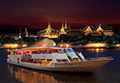
The program including 4 temples and 1 palace: Wat Arun (The Temple of Dawn), Wat Benchamabopith (The Marble Temple), Wat Trimitr (The Golden Buddha), Wat Pho (The Temple of Reclining Buddha), The Grand Palace & The Temple of the Emerald Buddha (Wat Pra Kaew).
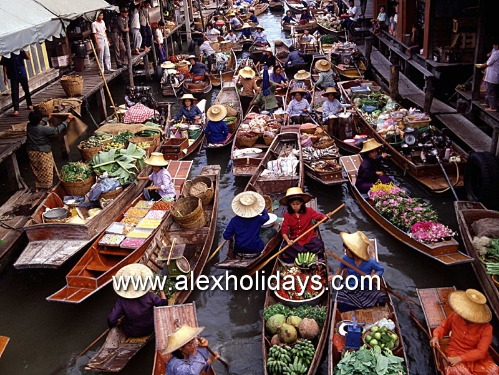
This authentic floating market is one of the most photographed places. It is located in Ratchaburi, about 100 km from Bangkok. Take a long-tail boat to the Floating Market where you will see the lifestyle of Thai people along the canal. Many vendors floating in their small rowing boats selling local food.
 Alex Holiday is a Bangkok-based travel agent, operating tour services and providing hotel reservations all over Thailand. We specialize in cultural, trekking, adventure and golf tours as well as other tailor-made tour packages. We can organize all kinds of travel for you. More details...
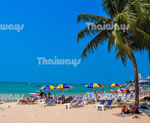
Pattaya Beach is divided into the north, central and south zones. The beach offers excellent facilities for watersports enthusiasts of all kinds.

Patong is the most famous beach in Phuket. With its wide variety of activities and nightlife, it is an ideal place to relax, party and play.

This 7-km beach is the longest and the most popular beach on the east coast of Ko Samui. It has clean white sand and clear blue water.

A popular beach destination about 3-hour drive from Bangkok. Its long sandy beach with a relaxed atmosphere is great for family holiday.